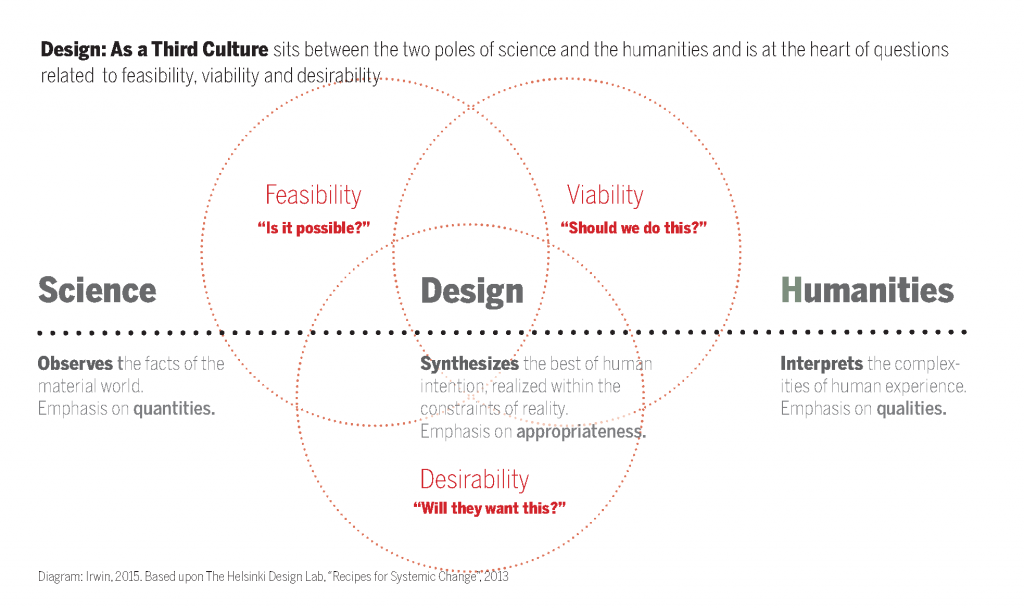
Within the last few decades, many ‘relational’ design approaches have emerged that emphasize the relationship between things rather than the design of things themselves. This development occurred within mainstream design (involving what Manzini calls ‘expert design’) as well as outside design, in disciplines such as biology, ecology and engineering (non-expert design). The evolution of expert design could be characterized as a move from early user-centered/interaction design approaches to experience design and finally to initial service design methods that began to address entire systems or ‘ecologies’ of relationships. These approaches, while focusing on ‘users’ and ‘customers’, seldom took social or environmental concerns into account.
Conversely, the work of researchers and practitioners from outside the design disciplines (in areas such as permaculture, ecological design and biomimicry) was based upon a deep ecological ethic and holistic worldview. These two groups rarely interacted and until recently, few individuals had successfully bridged this divide. This is beginning to change with the development of approaches such as lifecycle analysis, Cradle to Cradle, LEED, design for social innovation/social impact, participatory design, co-design, and policy design, which combine the methodologies and processes of expert design with the understanding of environmental and social systems from other disciplines. Transition design attempts a further integration by expanding and deepening the spatial/temporal context for complex, wicked problems and attempts to aggregate the knowledge, methodologies and skills necessary to seed and catalyze systems-level change. Transition Design aspires to bridge the gap between design and other disciplines by introducing an ecological world view and ethics into the former and making the tools and methods of design available to the latter.
See Additional Resources for this class before you begin the readings.
Close class by mapping an understanding of New Ways of Designing (Indigenous Design, Interaction Design with a Transition Design Mindset) onto the double diamond design process.
- Where might the skills, frames and perspectives learned in this section be most influential to a traditional design process?
The Double Diamond is a widely used visualization of the non-linear design process. Created by the British Design Council, the double diamond describes the divergent and convergent thinking designers employ in framing problems and designing well-considered, human-centered solution.
The first diamond describes the exploratory research phase of the design process, as designers conduct human-centered research to move from a general problem space towards a specific problem. From there, designers diverge once more to explore possible solutions before narrowing down towards a single design.