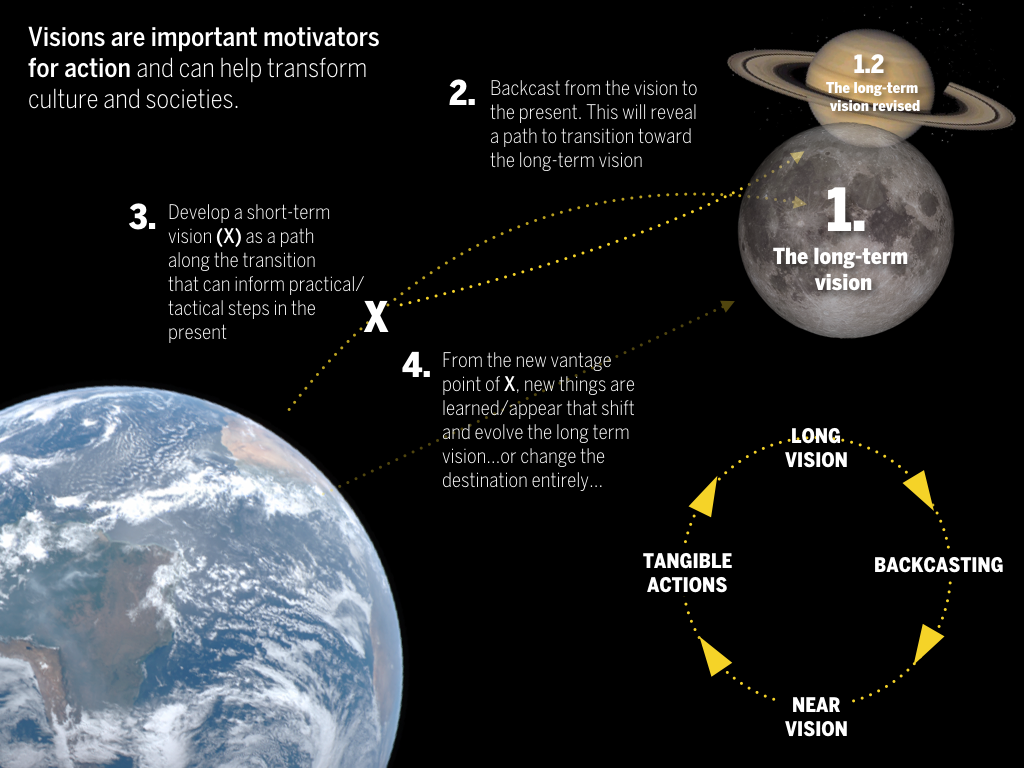
Transition Design proposes that more radically new ideas and compelling visions of sustainable futures are needed. These long term visions are conceived through a circular, iterative, error-friendly process that can inform small, discrete design solutions in the present Designers are uniquely suited to develop compelling visions of sustainable futures because of their experience in areas such as scenario development, future-casting and speculative design. Transition ‘visioning’ helps transcend the limitations of the present and creates a space in which we can speculate and wonder about how things could be. These future-based visions can serve as measures against which to guide, inspire and evaluate design solutions in the present. In order for designers to contribute to the development of compelling visions and narratives for a sustainable future, they need to acquire knowledge and skills that are emerging out of several new initiatives and organizations.
Design’s role can be seen here as less about solving assumed static problems, and more about understanding complexity and speculating in an informed way about how things could be different through co-creating visions: offering at once both propositions and statements, ‘This?’ and ‘This!’ as Dilnot (2015) puts it. Imagined futures can motivate, inspire, exemplify, horrify and provoke action; this would be a plural field, a flowering of alternatives which opens up discussion of, and provides examples—and potentially even ‘patterns’ for—different futures, with different voices, humble in its certainty, but confident in its challenge to existing paradigms. Design which adopts a singular, linear vision of ‘the future’, and future human behavior, does not deal adequately with the complexities of humanity, culture and society, let alone our place within the ecological systems of the planet.
See Additional Resources for this class before you begin the readings.